Running out of warehouse space is expensive, but leasing the wrong size temporary structure is a logistical nightmare. I have walked through too many facilities where plant managers only calculated the physical size of their boxes, completely forgetting that a warehouse is a high-traffic machine. Underestimating your footprint disrupts operational flow and creates serious safety hazards on the floor. Let’s get the math right the first time.
Quick Summary:
Choosing the right size involves calculating your total pallet footprint, adding 30-40% extra space for forklift turning radii and OSHA-compliant aisles, and selecting an eave height that fits your exact racking system. You must also map out staging areas for inbound freight and ensure your chosen structure meets local ASCE 7 wind and snow engineering standards.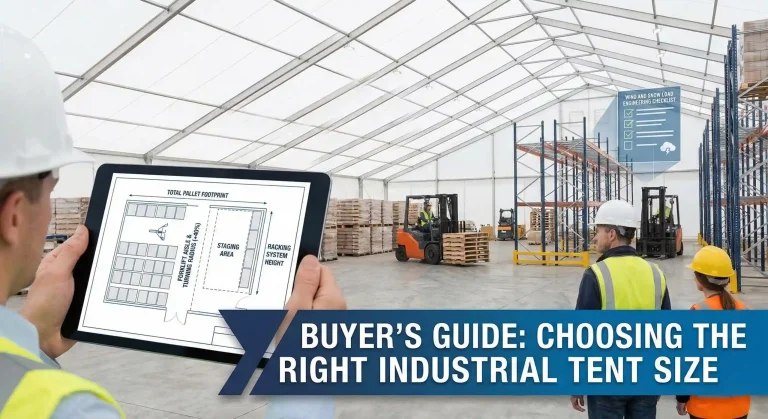
Step 1: Calculate Your Active Footprint (It’s Not Just About the Goods)
When mapping out a factory storage tent, you are not simply building a cover for your inventory. You are constructing a functional logistics hub. Calculating temporary warehouse space begins with your raw cargo volume, but it quickly expands once you account for human and mechanical movement.
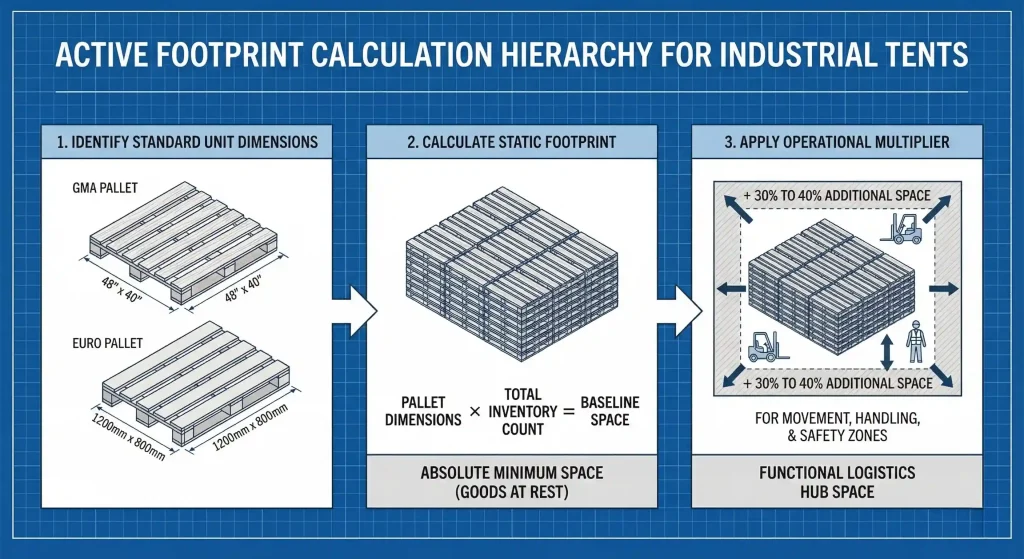
Follow this standard hierarchy to find your baseline square footage:
- Identify standard unit dimensions: Start with your base unit. Standard GMA pallets measure 48″ x 40″, while Euro pallets measure 1200mm x 800mm.
- Calculate the static footprint: Multiply your pallet dimensions by your total inventory count. This gives you the absolute minimum space your goods occupy when sitting perfectly still.
- Apply the operational multiplier: This is where most calculations fail. You must add a minimum of 30% to 40% additional space to your static footprint to account for movement, handling, and safety zones.
Factor in Forklift Turning Radii
Equipment needs room to breathe. Standard sit-down counterbalanced forklifts require a 12 to 15-foot (approx. 3.6m – 4.5m) turning radius to safely load and unload racking systems.
You must align your floor plan with OSHA standards right from the drafting phase. Safe pedestrian and equipment aisles must be clearly marked and strictly maintained. Pinching your aisles to save a few square feet leads to accidents, damaged racking, and destroyed product. If you fail to factor this “dead space” into your warehouse tent dimensions, your facility will suffer from chronic, daily bottlenecks.
Account for Staging, Receiving, and Quality Control
Inbound and outbound zones eat up floor space rapidly. Do not push your racking grids flush against your roll-up doors. You need dedicated staging grid coordinates at your primary entrances. Why? Because when three delivery trucks arrive simultaneously, you need temporary floor space to break down pallets, perform quality control checks, and organize the freight before it goes onto the racks. Without this buffer zone, you risk gridlock between the factory floor and the shipping yard.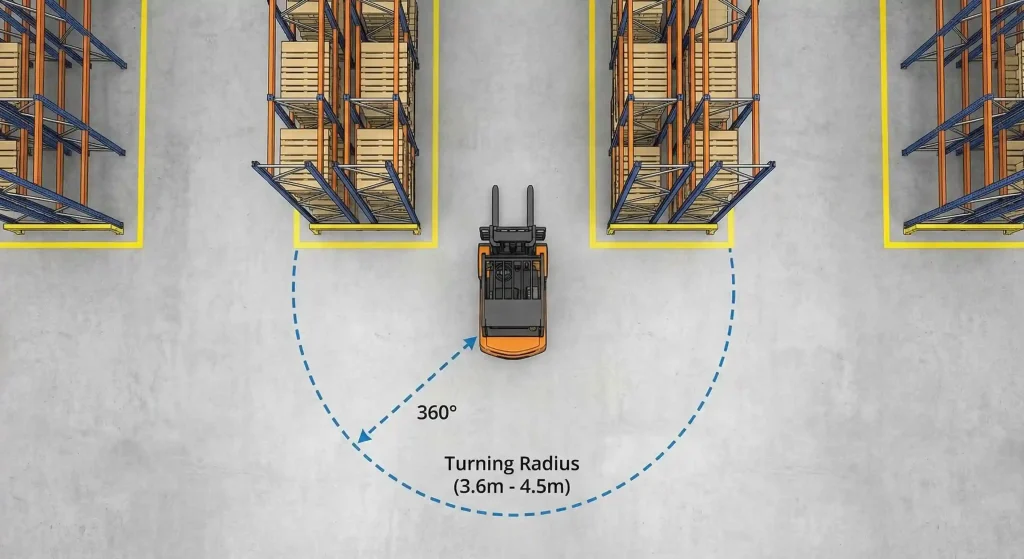
Step 2: The Costly Difference Between Peak Height and Eave Height
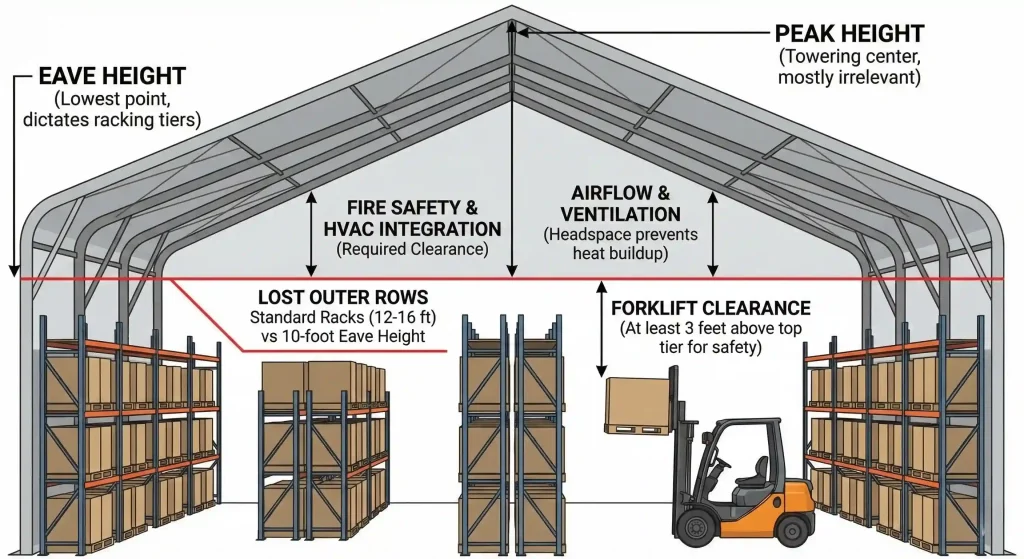
Do not let the towering center of a tent trick you. When working through an industrial tent size guide, the peak height (the very top center of the roof) is mostly irrelevant to your overall racking plan.
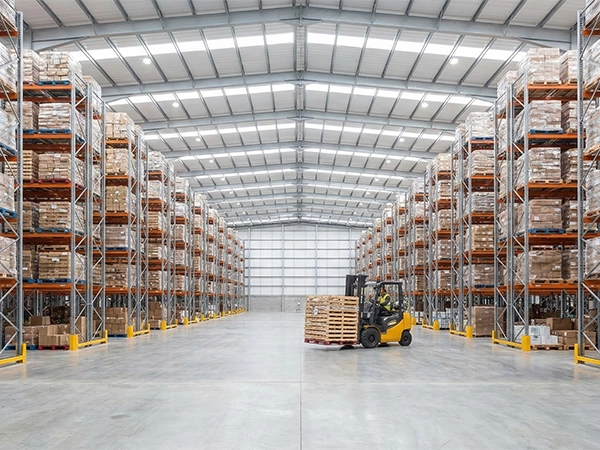
Eave height—the vertical clearance at the lowest point of the side wall—dictates exactly how many pallet racking tiers you can safely stack across your entire floor plan. Standard industrial racks often reach 12 to 16 feet. If you rent a structure with an 10-foot eave height, you immediately lose the outer rows of your vertical storage capacity.
Consider these specific vertical clearance factors before signing off on a design:
- Rack height limits: Ensure your side walls clear your top rack tier by at least three feet. Forklift operators need visual clearance to lift and place top-tier loads safely.
- Fire safety and HVAC integration: Local building codes mandate specific clearance requirements between the top of your highest stored goods and the roof structure. You need this space to integrate industrial lighting, HVAC ductwork, and fire safety systems.
- Airflow and ventilation: Packing inventory right to the ceiling restricts airflow. Adequate headspace prevents heat buildup, which protects sensitive inventory and keeps your floor workers comfortable.
Step 3: Why “Clear Span” Architecture is Non-Negotiable
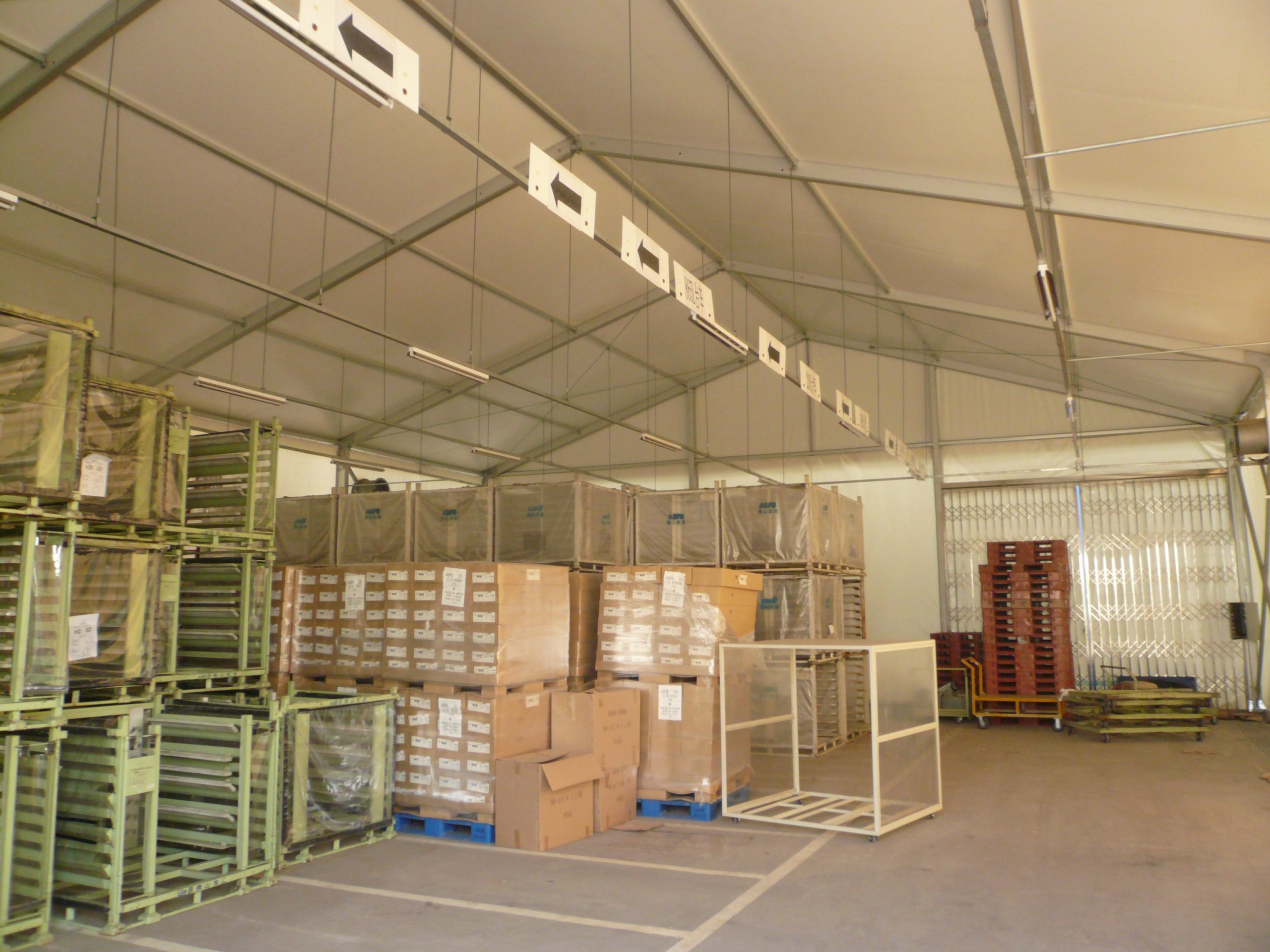
When sizing a high-volume facility, internal support columns act as permanent roadblocks. They ruin linear racking grids, create dangerous blind spots for equipment operators, and significantly reduce your total usable volume. Imagine navigating a loaded forklift around a massive center pole fifty times a shift.
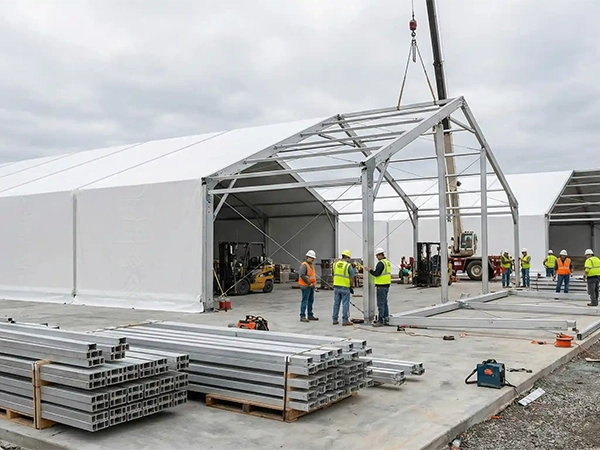
Clear span structure sizing eliminates this problem entirely. These engineered, heavy-duty extruded aluminum frames offer 100% usable interior space without a single interior column. You get an empty, unobstructed box. This allows you to design your floor plan entirely around your logistics flow, rather than forcing your daily operations to work around structural barricades.
Quick Reference Sizing Chart
Below is a highly practical baseline guide for estimating your footprint. These figures assume standard 48″ x 40″ pallets, 3-tier racking, a 14-foot eave height, and include a 35% space allowance for aisles and staging.
| Target Storage Capacity | Recommended Square Footage | Recommended Clear Span Width |
| 250 Pallets | 3,500 sq. ft. | 32 ft. (10m) |
| 500 Pallets | 7,000 sq. ft. | 50 ft. (15m) |
| 1,000 Pallets | 14,000 sq. ft. | 65 ft. (20m) |
| 2,000 Pallets | 28,000 sq. ft. | 100 ft. (30m) |
Step 4: Weather Loads and Local Engineering Standards
A temporary structure must offer permanent-grade protection. A large clear span facility faces immense aerodynamic pressure from wind and carries heavy structural burdens during winter storms.
Before finalizing your footprint, verify that the heavy-duty aluminum framework meets your local International Building Code (IBC) guidelines. Specifically, you need to check the ASCE 7 wind and snow load ratings for your exact zip code. A structure spanning 100 feet wide must be properly engineered to handle localized wind gusts and snow accumulation without risking a catastrophic failure.
Do not compromise on safety to save on the initial cost. Trust hard engineering data, not just the square footage on the quote.
Ready to nail down your exact specifications?
Stop guessing and let the engineering team at Shoulder Tent map it out for you. Contact us today for a 3D floor plan mockup and a custom sizing consultation. We will ensure your temporary warehouse is built perfectly for your operational reality.